

The King Power Club have accumulated about 1.33 points per game played this season. For a squad with the highest wages in the division, they were expected to dominate, even with performances being more lethargic. Marti Cifuentes and the players have struggled to impose themselves consistently and have been punished for this failure.
Unsurprisingly, so many supporters want to see heads roll. The Spaniard is a prime candidate, since offloading players is more difficult, and the board seems resistant or immune to consequences; the club needs refreshment to help deliver some improvement to results. Supporters and experts have mentioned Michael Carrick as a possible replacement.
What to know about Michael Carrick
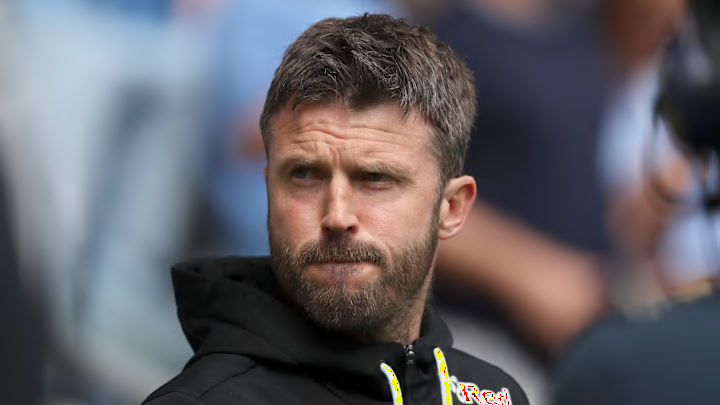
The Englishman was once a major player in the Manchester United squad under Alex Ferguson, and has recently managed Middlesbrough before the EFL Championship side decided to part ways with the head coach. The former player has not taken a permanent manager position since, but this has not stopped people speculating on him joining Leicester.
Over the 122 matches under his Middlesbrough tenure, Carrick's team accumulated a total of 1.54 xG per game and scored a total of 1.64 goals per game (helped by some large wins). This illustrates that, although not explosive, Boro's system consistently produced high levels of creativity and outperformed their expectations.
If you compare that to Leicester City this season under Cifuentes, the Foxes have 1.18 xG per game and actual goals at 1.17. It is probably not necessary to state what this illustrates, but I shall for journalistic clarity. The Spaniard's team is less creative and underperforms even from that less creative place. A lack of clinical finishing and elite creativity leaves Leicester with more draws and losses than they should, whereas Carrick's Boro took more wins and draws instead.
To understand which players might be considered winners or losers, we will need to know how Michael Carrick set out his team. It is easy to argue that Carrick, a student of Ferguson and other elite coaches, will have a certain tactical set-up and philosophy which would dictate the game time and importance of particular players.
Structurally, the English headcoach usually starts with the base 4-2-3-1, which adapts during fixtures between a 4-4-2/4-4-1-1 depending on attacking zone or defensive zone (as well as if the team are under pressure or needs to apply pressure), and a 3-2-5 when the team has significant possession. In effect, the Englishman brings a possession-demanding, progression-based system that recycles the ball, does not rely on ultra-fast passing (like the tiki-taka style), and does not make excessive use of long balls over the top or straight to an attacker.
The build-up play and comfort level on the ball are vital strengths for players who want to be in this system. A player cannot be someone who hates receiving the ball under pressure, panicking before rushing a pass, or someone unable to be space-aware and move dynamically to respond to pressure. In essence, technically gifted, versatile players are preferred in this system.
Three Winners (and losers) if Michael Carrick joins Leicester
In this system, the left-back and right-back take on two different roles. The right-back does not join midfield (in that Pep Guardiola popularised system), but instead joins the centre-backs to form a back three with three defenders who are comfortable on the ball, have a progressive goalkeeper supporting them, and are capable of covering the wide spaces in a fast transition. The left-back is a marauder: their goal is to either get an early cross into a flooded box, or overlap with the winger for a low cross or cutback pass to an inside forward.
Luke Thomas is an alright left-back. Under Brendan Rodgers, we needed that early crossing, long throws, and relatively consistent defending. Unfortunately, the English left-back has not really shown the aggressive attacking intent that would follow for a Carrick-inspired system. The defender can be more conservative, worried about what is happening behind him as his partnered centre-backs are not always mobile enough to cover the wide spaces, and our defensive midfielders seldom screen on the transition.
This means Victor Kristiansen could be the biggest winner. Going from only 129 minutes currently to perhaps a first-teamer. The Danish left-back has not always shown a consistent defensive ability to snuff out attacks, but he has displayed plenty of aggression going forward, usually without the ball, to support a left-winger with an overlapping run. That is vital to how Middlesbrough progressed and created in the final third, and that would be just as vital to how Carrick would set up the Foxes. The left-back needs to provide the attacking width while the rest of the team narrows to flood the box. Kristiansen would do a much better job of this than Thomas.
At central defence, Carrick's system relies on mobility and a capability to cover wide spaces quickly, or cooperate with a corresponding fullback/midfielder to break presses with neat space-based passing. It should be fairly clear that Wout Faes, with half the minutes of Jannik Vestergaard, becomes the clearest winner at the back: he is more mobile, can be quicker, and can maraud forward with support from right-back as in the Boro system. The Belgian would undoubtedly become one of the first names on the lineup.
Conversely, then, it is difficult to say which defender would lose out. The Danish defender has been one of our best players this season under Cifuentes. Despite a general lack of off-the-ball movement from the team, Vestergaard has pushed forward, shown an elite long-ball distribution, and overall composed defending. However, his mobility - or lack thereof - would not be conducive to the system we should expect Leicester City to deploy. So, the defender could end up being replaced by the more fitting and adaptable Caleb Okoli.
As a note, I would say Harry Souttar would be the biggest loser. From his playing stint, we did not see a player comfortable on the ball in large passages of possession, but we did see an aerially dominant and positionally intelligent defender. The player has been injured for a long time, so I do not think it makes sense to call him a 'loser' in the Carrick system. Besides, it could be useful to have that central defender (the middle of the in-possession back three) be someone with a better aerial capability and defensive success rate.
Upfront, fluidity is the name of the game. The No.9 and No.10 will often shift and move, bouncing off each other and around one another, shifting who is upfront and often drifting wide or into the half spaces. This requires a mobile, pacy, versatile forward who can do multiple tasks as well as link up play. This requires Patson Daka.
The Zambian striker has not been at his best this season (or previous ones), although recent games have been more promising. Nonetheless, Daka can shift out wide, can run in-behind, can drop deep to collect the ball, and can interplay with an attacking midfielder like Aaron Ramsey or Bobby De Cordova-Reid. Meanwhile, the other option - Jordan Ayew - would be one of the biggest losers in the system. Although positionally versatile, his immobility and general lack of consistent energy would be a tempo drain on the fluid attack, and mean some spaces are unexploited without this mobile centre-forward going into them quickly enough.
As a note, a player like Jake Evans could be transformed under a Michael Carrick-style system. A versatile wide-forward to centre-forward, the youngster is a goal-machine that understands where the net is and interplays very well with wingers and attacking midfielders, the exact fit for the No.9 role in this system. If the player got their chance under the Englishman, it is not inconceivable to see Evans as a possible winner.
To conclude, should Leicester City hire Carrick, they would be abandoning the Guardiola-inspired system they currently have and shift to a more fluid and dynamic system reliant on the technical quality of their players. To do so, mobile and versatile players like Faes, Kristiansen, and Daka could benefit immensely, while players such as Vestergaard, Thomas, and Ayew, who are less mobile, could suffer.
 Add us as a preferred source on Google